@david It's like Rummy but with more freedom which makes it a hell lot more interesting. You're allowed to manipulate everything that's on the table, trigger jokers, recombine the cards as long as there are at least three in a row after your move, not just simply add cards to existing rows (or whatever the correct terminology is). It's good fun and mental exercise.
Timeline
Recent posts from feeds followed by sorenpeter@darch.dk
@zvava CORS is our worst enemy. 🥷
I too had the same issue being a browser-based request, so the only solution is using a proxy.
For testing (and real personal use) I rely on this one https://corsproxy.io/.
In my client, I first check if the source allows me to fetch it without issues first and fallback to prefixing with a proxy if it gives an error.
For security reasons the client don't give you a readable error for CORS, so you must use a catch-all for that, if it fails again with the proxy you can deal with any other errors it throws as you normally would (preferably outside of the fetch function).
After the fetching responded, I store the response.url value to fetch it again for updates without having to do extra calls (you can store it verbatim or as a flag to be able to change the proxy later).
Here an extract of my code:
export async function fetchWithProxy(url, proxy=null) {
return await fetch(url).catch(err => {
if (!proxy) throw err;
return fetch(`${proxy}${encodeURIComponent(url)}`);
});
}
// Using it with
const res = await fetchWithProxy('https://twtxt.net/user/zvava/twtxt.txt', 'https://corsproxy.io/?');
// Get the working url (direct or through proxy)
const fetchingURL = res.url;
// Get the twtxt feed content (or handle errors)
const text = await res.text();
I also plan to allow the user to define a custom proxy field, I like the solution used by Delta.chat in their android app, where you can define the URL format with a variable https://my-proxy?$TWTXT_URL since it allows you to define with more freedom any proxy without a prefix format.
If the idea of using a third-party proxy is not to the user liking they can use a self-hosted solution like cors-anywhere or build their own (with twtxt it should just be a GET).
@lyse @prologic Can't we find a middle ground and support both?
The thread is defined by two parts:
- The hash
- The subject
The client/pod generate the hash and index it in it's database/cache, then it simply query the subject of other posts to find the related posts, right?
In my own client current implementation (using hashes), the only calculation is in the hash generation, the rest is a verbatim copy of the subject (minus the # character), if this is the common implemented approach then adding the location based one is somewhat simple.
function setPostIndex(post) {
// Current hash approach
const hash = createHash(post.url, post.timestamp, post.content);
// New location approach
const location = post.url + '#' + post.timestamp;
// Unchanged (probably)
const subject = post.subject;
// Index them all
addToIndex(hash, post);
addToIndex(location, post);
addToIndex(subject, post);
}
// Both should work if the index contains both versions
getThreadBySubject('<a href="?search=abcdef" class="tag">#abcdef</a>') => [post1, post2, post3]; // Hash
getThreadBySubject('https://example.com#2025-01-01T12:00:00') => [post1, post2, post3]; // Location
As I said before, the mention is already location based <a href="/timeline/profile?url=https://example.com/twtxt.txt">@example</a>, so I think we should keep that in consideration.
Of course this will lead to a bit of fragmentation (without merging the two) but I think this can make everyone happy.
Otherwise, the only other solution I can think of is a different approach where the value doesn't matter, allowing to use anything as a reference (hash, location, git commit) for greater flexibility and freedom of implementation (this probably need the use of a fixed "header" for each post, but it can be seen as a separate extension).
On my blog: Developer Diary, Freedom to Marry Day https://john.colagioia.net/blog/2025/02/10/freedom-marry.html #programming #project #devjournal
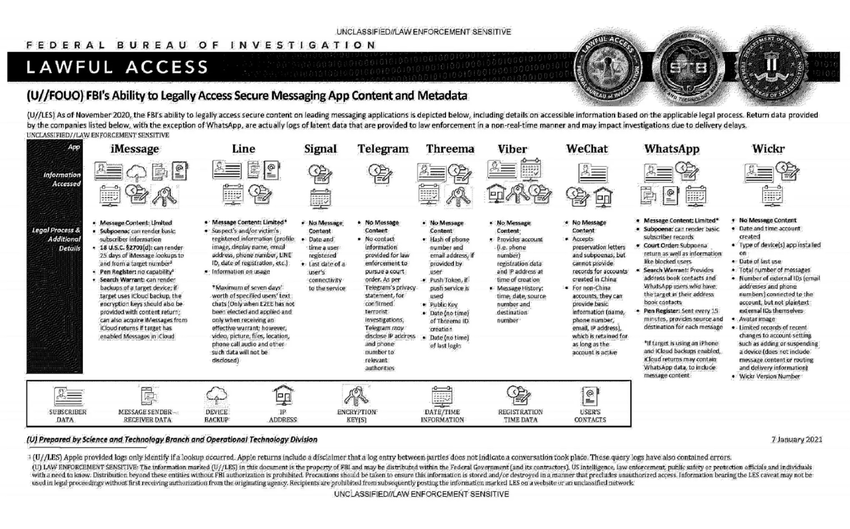
An official FBI document dated January 2021, obtained by the American association "Property of People" through the Freedom of Information Act.
This document summarizes the possibilities for legal access to data from nine instant messaging services: iMessage, Line, Signal, Telegram, Threema, Viber, WeChat, WhatsApp and Wickr. For each software, different judicial methods are explored, such as subpoena, search warrant, active collection of communications metadata ("Pen Register") or connection data retention law ("18 USC§2703"). Here, in essence, is the information the FBI says it can retrieve:
-
Apple iMessage: basic subscriber data; in the case of an iPhone user, investigators may be able to get their hands on message content if the user uses iCloud to synchronize iMessage messages or to back up data on their phone.
-
Line: account data (image, username, e-mail address, phone number, Line ID, creation date, usage data, etc.); if the user has not activated end-to-end encryption, investigators can retrieve the texts of exchanges over a seven-day period, but not other data (audio, video, images, location).
-
Signal: date and time of account creation and date of last connection.
-
Telegram: IP address and phone number for investigations into confirmed terrorists, otherwise nothing.
-
Threema: cryptographic fingerprint of phone number and e-mail address, push service tokens if used, public key, account creation date, last connection date.
-
Viber: account data and IP address used to create the account; investigators can also access message history (date, time, source, destination).
-
WeChat: basic data such as name, phone number, e-mail and IP address, but only for non-Chinese users.
-
WhatsApp: the targeted person's basic data, address book and contacts who have the targeted person in their address book; it is possible to collect message metadata in real time ("Pen Register"); message content can be retrieved via iCloud backups.
-
Wickr: Date and time of account creation, types of terminal on which the application is installed, date of last connection, number of messages exchanged, external identifiers associated with the account (e-mail addresses, telephone numbers), avatar image, data linked to adding or deleting.
TL;DR Signal is the messaging system that provides the least information to investigators.
On my blog: Developer Diary, World Freedom Day https://john.colagioia.net/blog/2023/01/23/freedom.html #programming #project #devjournal
The freedoms you surrender today are the freedoms your grandchildren will never know existed.
He loves freedom of speech so much he wants to buy a publicly traded company to stop a 14 yo from posting his private jet flight plans.
In this same vein I condemn Israel and their apartheid state and I stand with Palestine. Freedom for the downtrodden
On the blog: Developer Journal, World Press Freedom Day https://john.colagioia.net/blog/2021/05/03/press.html #programming #project #devjournal
søren peter mørch